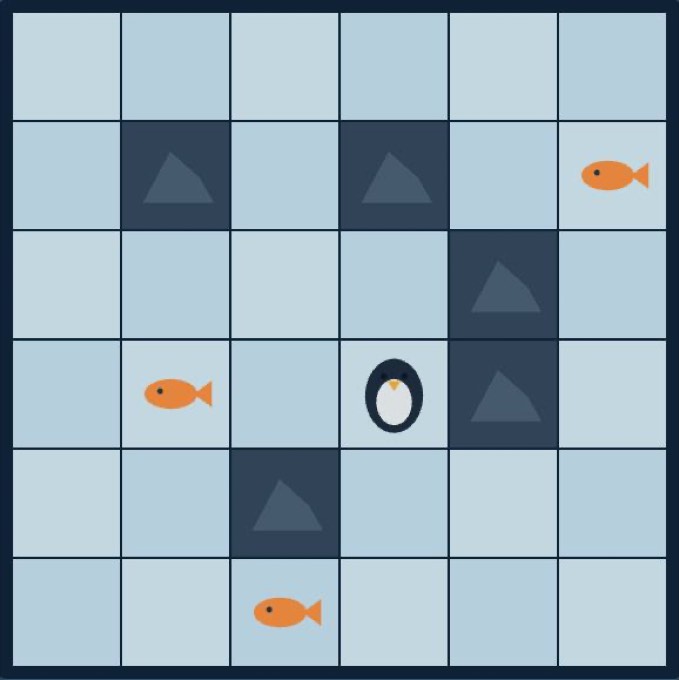
Floe puts a penguin on a sheet of ice with scattered rocks and fish. A push carries the penguin in a straight line until a rock or the edge stops it. You collect fish on every cell you cross. A good route is a chain of useful stopping positions that passes over every fish with as few slides as possible.
How to play Floe
Use the arrow keys or WASD on a keyboard. On a phone, swipe in the direction you want to move, or tap toward that side of the penguin. Wait for the slide to finish before you enter the next move. Use Undo to revisit your previous position or Reset to start the board again. The daily goes through three boards, each with its own par.
Floe tips
Look for fish a long slide can collect together. A fish in the middle of a lane is collected while the penguin crosses it, so you can plan a route that reaches a useful stopping point farther away. A fish awkwardly parked one row away can be harder: you may need a wall or rock to get the penguin around to the side of that row.
Plan backward for the fish with the fewest entrances. Pick a horizontal or vertical lane through it and ask which cells could be the endpoints of a slide into that lane. If a rock is immediately beside a candidate landing square, it may give you the stopping point you need. This often reveals the route's essential setup before your first move.
Say you have two fish in a horizontal corridor and one in a column branching from it. A slide can collect the pair. Before taking it, check which end of the corridor gives you the best angle for that third fish. If your current move ends on the wrong side, it can cost several extra slides to get around the rocks and return to the same lane.
Create a stop before you collect the fish
Picture a fish in the central column one square above a rock, with the penguin starting on the far side of the board. A sideways slide along the fish's row will collect it if you can enter that row. Try approaching the rock from above. It will stop the penguin on the row you need. Now you can look for an earlier slide that puts the penguin into the rock's column without spending moves clearing a dead-end corner.
Different boards reward different openings. On open ice, corners and edges tend to provide the only braking points. On boards with many rocks, two adjacent rows can lead to very different results because one lane stops and the other keeps going. Compare your slide count for each board to its par at the end. If only the middle board took extra slides, replay or practice that style of board and focus on the first stop that sent you on a detour.