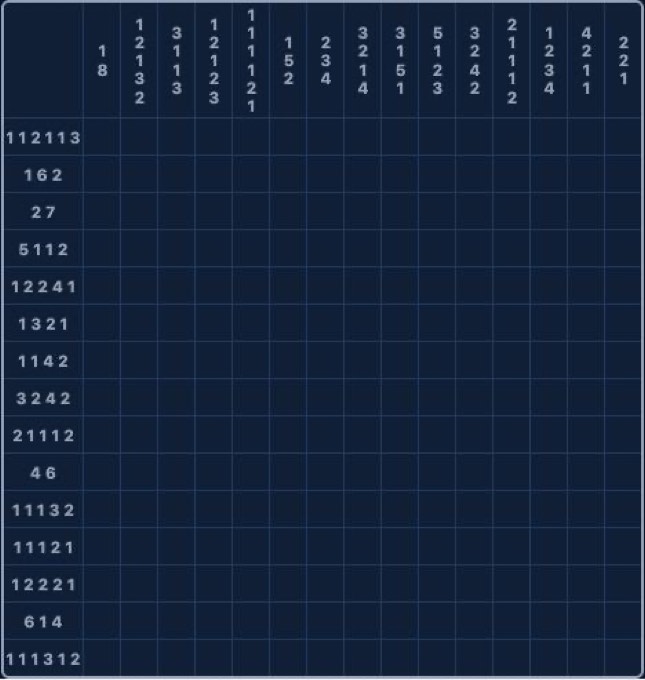
A daily nonogram is a picture puzzle with number clues at the start of each row and column. A clue describes the lengths of the consecutive blocks of filled cells in that line. As you fill cells and mark empty ones, the two sets of clues constrain each other. The completed grid reveals a small pixel image.
How to play Daily Nonogram
Read each clue in order and tap cells to paint them. Use the Mark mode on a phone or the secondary mouse button to mark squares that must be empty. The player lets you drag to paint a run. Leave uncertain squares untouched while you look at their intersecting clues. The puzzle is solved once your filled cells match the required picture.
Daily Nonogram tips
Start by measuring the minimum space a line needs. On a ten-cell line with clues 4 2 2, the runs use eight cells and the two required separators use the remaining two. The entire line has one possible arrangement. A line with just a 7 on ten cells leaves room at either end, but the center cells common to every placement must be filled.
After filling one forced block, check whether the bordering cells can be excluded. If a block is already full and is the only possible home for its clue, it must have a gap before the next block. Intersecting columns can turn those marks into new forced fills. Switch between rows and columns each time you finish an obvious stretch.
Work from evidence for short isolated runs. A filled cell near one end of a row may belong to the first or second clue until an X separates the two regions. Check the other direction before extending that run. As the picture comes into focus, use the clues to settle ambiguous details instead of filling them according to what the image seems to depict.
Use overlaps and boundaries together
On a ten-cell row with one run of seven, its leftmost placement occupies cells one through seven and its rightmost placement occupies four through ten. Cells four through seven occur in both extremes and every placement between them. Fill those four cells first. Any unknown on either side still depends on which placement the crossing clues permit, so leave the ends open for now.
Now imagine a column through cell four has a single clue of 1. That column can take only the one filled square you just placed. Mark the others as empty and look at the rows those marks split. If a mark separates a wide region from a narrow one, a longer run may only fit in the wide region. This is how a modest overlap in one direction can determine the placement of a different run elsewhere without using the final picture as a guess.