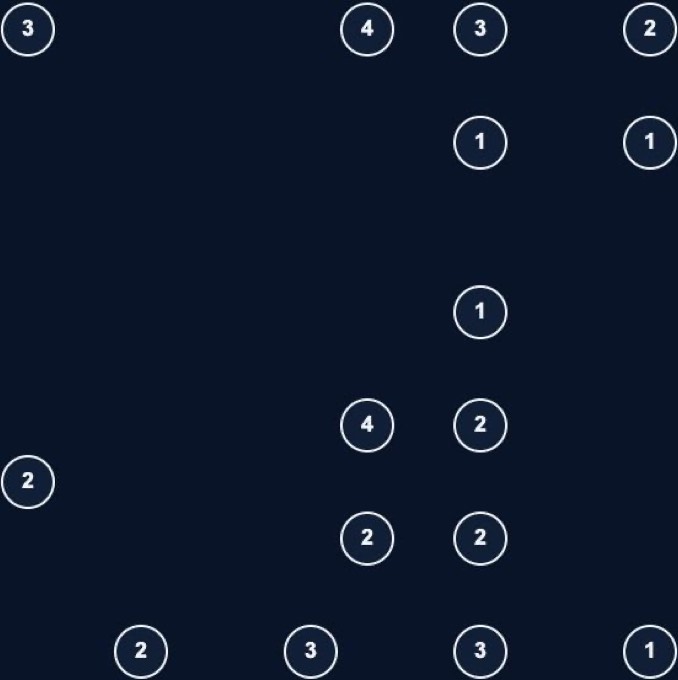
Hashi is a bridge-building logic puzzle. Islands show how many bridges they need. You can connect islands that see one another directly along a row or column, with a maximum of two bridges per pair. Lines cannot cross, and every island must eventually connect to the same network. The local totals and the global connection rule have to hold at the same time.
How to play Hashi
Select two visible neighboring islands to draw a bridge. Repeat the connection to cycle through a single bridge, a double bridge and no bridge. Use the island labels to track how many bridges remain to be placed. Read across and down for legal neighbors. A number behind another island or across an existing bridge is out of reach on that line.
Hashi tips
Start with an island that has few exits. For instance, a 3 with just two legal neighbors needs at least one bridge in each direction. A 4 with two available neighbors needs two in each direction. Place those forced bridges first, then revisit any island whose options changed after you drew them.
Look for bridges you can rule out even when both endpoints have room. Two 1s joined to each other would form an isolated component unless they were the entire puzzle. Similarly, a nearly finished cluster needs at least one remaining connection to the rest of the board. Check the totals around its border before filling its last internal gap.
Treat a double bridge as one route with a count of two. Using a double bridge will meet more of a neighboring number, but it cannot link a second cluster on its own. When you make a new route, look for the perpendicular lines it blocks and recalculate the useful neighbors in that area. A new crossing restriction often forces another island's only remaining exit.
Work a small group without trapping it
Take three islands in a row whose labels are 1, 2 and 1. If the middle island has no other legal neighbors, each side needs one bridge. Before placing them, check for a perpendicular escape from either end. If those 1s each spend their full count on the middle 2, the group cannot connect to other islands. A real grid with additional islands cannot resolve this group in that way. That contradiction tells you to revisit which exits are genuinely blocked.
An island labeled 2 can also use a double bridge or a pair of single bridges. Look at its neighbors' remaining capacities before deciding between these options. If each of two legal neighbors still needs exactly one bridge and no third direction is open, they force a single toward each. When you draw the pair, check the islands on the other side of both routes. Their available lines may have changed in two places at once.