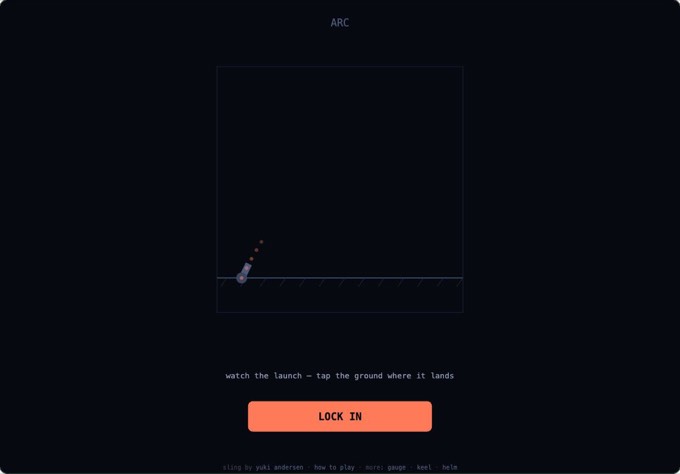
Sling takes five motion problems and asks you to call the result before the scene plays out. Predict where a cannon shot lands, where a released ball crosses a ring, how a gear turns, where a rebound lands and where two moving objects meet. The setup gives you enough motion to form a prediction. The replay shows what your marker missed and gives you a different angle on the physical idea.
How to play Sling
Place a marker on the illustrated ground, ring or field, then use Lock In. The gear round has clockwise and counterclockwise choices. Read the arrow on the first gear and follow each connection. Some screens animate the first part of a motion before you answer. Watch that cue through at least once and use it together with any fixed arrows or guides.
Sling tips
In Arc, compare how far the ball moves sideways while it first climbs. The tilt of the launcher can help you judge the trade-off between that sideways motion and time in the air. In Spin, imagine the ball exiting on a straight line tangent to its circular track at the cut point. The radius reaches outward while the release direction lies across it at right angles.
For Gears, count the number of reversals. If three direct meshes follow a clockwise driver, the last gear turns counterclockwise. When the game shows a belt connection that preserves direction, leave it out of the reversal count. The gear task has a clock, so use parity as a shortcut once you understand the strip.
In Bounce, picture the angle the incoming path makes with the pad. Draw the departure on the other side of the perpendicular to that pad and follow it to the ground. In Meet, consider how much time it takes each dot to travel to the crossing. The faster dot covers more distance in the same time, so the collision point can be closer to the slow dot’s starting position.
Check what the replay is showing
When you miss the Spin round, pause on the picture of the cut point. Imagine a wheel rolling over level ground with a sticker at the top. The sticker's circular motion at its highest point is sideways. That picture gives you a way to check the tangent when the cut notch is at an unfamiliar angle. Move the reference around the ring before deciding which side of the outer circle the ball should cross.
In Bounce, use the pad surface to choose the normal before reading either angle. A steeper pad rotates the normal and changes where the rebound travels, even with the same incoming path. During the reveal, follow the ball past its first contact and see whether your miss came from the rebound angle or from judging how far it would travel after leaving the pad. Keep that distinction for the next puzzle where the pad tilts in the other direction.