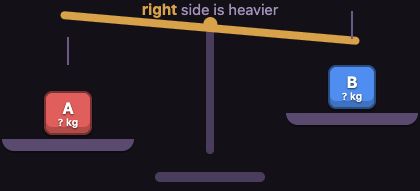
Ballast hands you five crates that look alike and weigh 1, 2, 3, 4 and 5 kilograms in some order. Balance It Game asks whether a layout will hold. Ballast asks what the scale can tell you about something hidden. With no printed weights, every placement is an experiment. You win by turning the directions of those tilts into one complete light-to-heavy order.
How to play Ballast
Tap a crate to cycle it from the bench to the left pan, then to the right pan and back again. Press Weigh to record how the pans compare. You can load several crates together. Once you have an order, place the crates in the answer slots from lightest to heaviest and submit. Use the on-screen history to check whether your proposed order agrees with every comparison you made.
Ballast tips
One-against-one is the easiest comparison to write down. If blue sinks against orange, write orange < blue. If orange then sinks against green, you have ordered three crates from just two tests. Follow up with a weighing that would come out differently for the two orders you still consider possible.
Equal readings are especially useful with two crates on each pan. For example, if two different pairs balance, their members cannot include a 1 and 2 together: no other two distinct available weights can also sum to 3. The fifth crate stays on the bench and becomes part of what you can infer.
Before submitting, read the pans again in your notes. A heavy-left result only supports orders in which the sum on the left exceeds the sum on the right. The game scores comparisons, so a promising guess and an informative weighing cost different things. If a guess is wrong, the game adds a weighing to your score and reports how many crates were in the correct position. Use that feedback with your notes to choose what to test next.
Work through one scale reading
Imagine the scale balances A and B against D and E, while C stays on the bench. Both sides have the same whole-number total. All five weights add to 15, so removing C leaves an even total. That tells you C is odd. It could be 1, 3 or 5. If you weigh C against a crate from one of those pairs, the tilt may eliminate an entire family of arrangements at once.
Compare that with testing A against B. Such a test tells you which member of one pair is heavier, but it might leave all three possibilities for C open. Either comparison is legal. Before pressing Weigh, count which hypotheses the outcomes would remove. On the first few moves you can usually think in groups, such as “C is the lightest or C is somewhere in the middle.” Save the detailed order for when the scale history has already narrowed those groups.