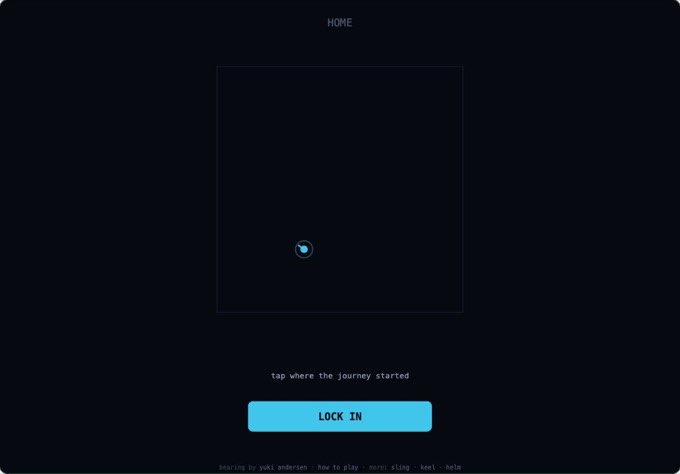
Bearing follows a walker through five small journeys. The path disappears as the walker moves, then the game asks you to recover a starting point, direction, end point, distance or shorter route. It is a test of dead reckoning: you use the turns you saw and your estimate of how far each leg went. Each answer earns a score for how close or how quick your judgment was.
How to play Bearing
Start each round and watch the playback. Tap the map, compass ring or distance ray once the movement stops. For Track, choose one of the two displayed paths. Drag to adjust a marker if the task offers a free position, then select Lock In. The arrow keys can fine-tune desktop placement. Wait for the walk to finish before moving your marker.
Bearing tips
In Home, remember the start as a location on the screen and mentally cancel movement in opposite directions. If the walker goes a little east, a lot north and then farther west, the starting point lies southeast of the finish. That same reasoning gives you the angle for Face. Use the compass ring to set only the direction and leave distance out of the decision.
In Ride, establish a reference direction before the first turn, then track whether each turn was left or right relative to the walker’s current heading. When the map comes back with north at the top, translate your overall displacement. A landmark you passed can anchor your mental picture without being your final position.
In Span, the homeward ray gives you the angle, so you can focus on how long the shortcut should be. Think of the two outbound legs as two sides of a triangle and the shortcut as the third. In Track, compare the lengths of the bends and straight sections on both routes. The easier path to follow with your eye can still be the longer choice.
Keep a consistent frame of reference
Try one short mental sketch while the walker is moving. Use the first flag as the origin. A leg north followed by an equally long leg south cancels in the vertical direction, even if an eastward leg sits between them. At the end, the remaining offset in that example points east. To answer a Face question about home, reverse that displacement and point west. To answer a Ride question about where you finished, keep it pointing east.
For a curving candidate in Track, count its notable sections rather than judging the straight distance between the endpoints. Both choices can start and end in the same places, so the differences come from the travel between them. Look for a detour that first moves farther from home or a loop that turns back across a straight alternative. That quick check makes the choice easier without needing to measure each segment.