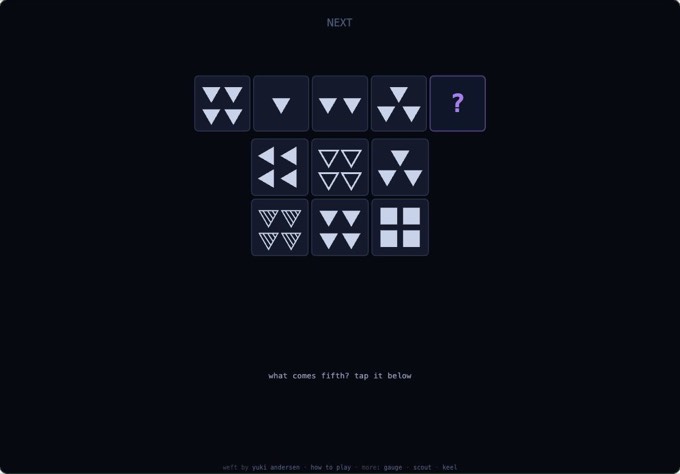
Weft is a five-round visual reasoning game. Each round asks you to identify a rule in a row, comparison or grid of shapes. You might predict what comes next, find the one panel that breaks an agreement or apply a transformation to a new shape. The challenge is to name the property that changed, then spot the answer among options that look deliberately similar.
How to play Weft
Read the prompt, start the round and tap a panel to answer. Next and Grid ask you to complete a pattern. Oddset and Rulebreak ask for the exception. In Flow, watch the short demonstration of the first change and apply it in the same direction to the new panel. Use the on-screen feedback to see which property the puzzle was testing.
Weft tips
Scan one property across the whole pattern before switching to another. Count the objects in each panel, then compare shape, fill and rotation. If the counts stay constant, consider which of the other features makes predictable steps. In Oddset, a single feature has to unify four panels. The brightest shape can look like the exception even while it agrees with the other four on that property.
In Flow, say the transformation in a few words, such as “one quarter turn clockwise” or “one extra shape.” Check that sentence against both examples. An answer can look familiar because it applies the same rotation backward. Use the demo to settle the direction before you commit.
In Grid, read a full row and a full column. A simple matrix could increase the number of objects left to right but switch the fill top to bottom. An answer that matches the right count can still fail the column's fill rule. In Rulebreak, identify both shared properties first, then check which choice differs on one of them. This approach also helps when two choices stand out for unrelated visual reasons.
Compare the tempting wrong choices
After a miss, name the property your chosen panel got right and the property it got wrong. A panel might match the increment of the sequence but use the last repeated orientation. That is a different mistake from choosing the correct orientation with a count one step behind. Looking at the wrong choice this way makes the visual feedback easier to carry into another round.
For a practice example, take a sequence with one triangle, two triangles, three triangles and four triangles. The fill alternates solid, outline, solid, outline. Predict that the fifth panel needs five triangles and a solid fill before looking at the choices. A crowded answer bank often makes a viable-looking choice feel correct. State the expected features first and use both when scanning the row. The same approach works when the panel changes a rotation instead of a fill.