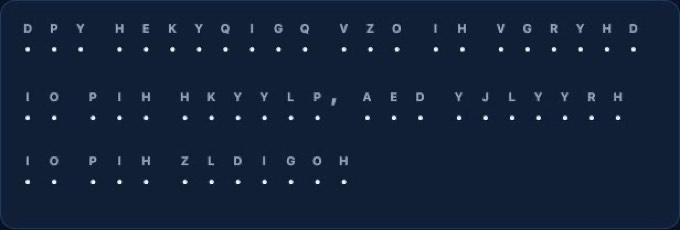
A daily cryptogram gives you a short quotation in a substitution cipher. Every occurrence of an encoded letter stands for the same plain letter. Spaces and punctuation reveal the shape of words, while the identities of the letters remain hidden. The more of the sentence you decode, the more places you have to test your next guess.
How to play Daily Cryptogram
Tap an encoded character in the quote, then select a plain letter on the keypad. The game displays the assignment everywhere that encoded letter appears. Read the neighboring words after each choice. If a guess produces inconsistent text, clear it or replace it. Solve the full quote to see the result.
Daily Cryptogram tips
Look for one-letter words, apostrophes and duplicated letters. A one-letter word in an English quote could be A or I. Either guess will affect every word that uses the same symbol, so check whether the surrounding phrase suggests an article or a pronoun. A repeated symbol in the middle of a word can point toward a small group of familiar spellings.
Compare word shapes. An encoded word with a pattern like ABBA needs its first and last letters to match and both middle letters to match each other. If you recognize a possible word in a partially filled quote, check its entire pattern and all its known letters before assigning anything new.
Frequency gives you candidates. A frequent symbol might stand for E, T or A, but a short quote can favor an uncommon letter simply because a word repeats. Test your best candidate against two or three words. Once a few longer words emerge, read the sentence aloud in your head and look for phrases that are credible in both grammar and meaning.
Use repetitions to test a possible quote
Suppose you see an encoded four-letter word with the first and third positions matching. The plaintext ELSE fits a different repetition pattern because its first and fourth positions match. A word like EVER does fit the first-and-third pattern. That still leaves the rest of the quote to check. Substitute those letters where they recur and see whether they create plausible beginnings and endings in nearby words.
Look for punctuation that constrains the reading. A short word before a comma could be part of a self-contained expression, while an apostrophe with one trailing letter might suggest an English possessive or contraction. Use those cues to choose between candidate mappings. When changing a guess, revisit every word that used it and see whether the new reading improves several of them together. This prevents a long and promising word from locking you into an assignment that contradicts a shorter phrase elsewhere.
When the last few symbols are open, read whole clauses rather than treating each remaining tile by itself. Verb tense, singular or plural endings, and short connecting words can narrow several final assignments at once.