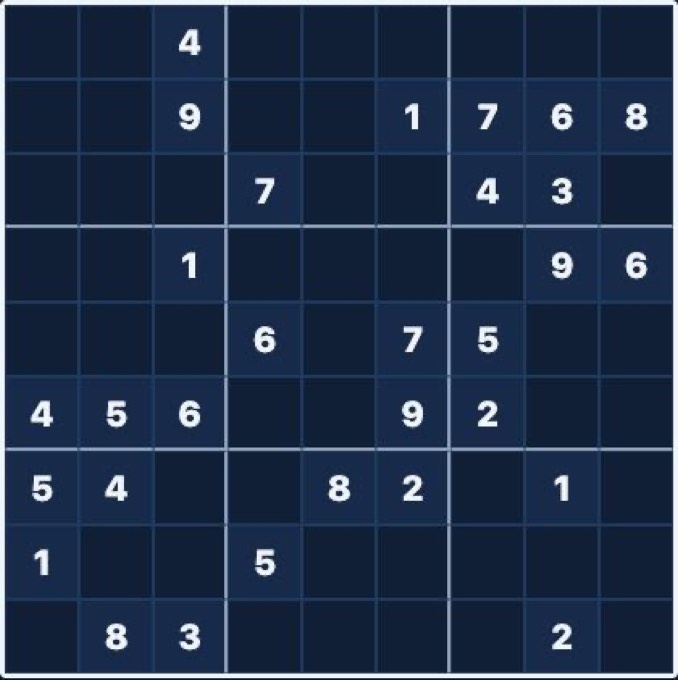
Daily Sudoku uses a nine-by-nine grid divided into nine three-by-three boxes. Each row, column and box must contain the numbers 1 through 9 exactly once. A daily board starts with fixed digits that restrict the remaining cells. You can solve a surprising amount of the board by looking for where a number is allowed to go, without having to choose between equally plausible guesses.
How to play Daily Sudoku
Tap an empty square and select a digit on the keypad. Fixed clues stay in place. Use the erase control to remove an entry and check any conflicts highlighted by the game. Look at a cell's entire row, column and box before deciding whether a digit belongs there. Keep placing forced values until every unit contains all nine digits.
Daily Sudoku tips
Scan one number at a time across neighboring boxes. If a box already has a 7 in the top strip and another box has a 7 in the middle strip, their rows may rule out two lines of cells in the remaining box. A placement can become forced even when most cells are still blank. This is often easier than listing every candidate in the first square you see.
Switch between two ways of finding singles. A naked single is a cell that can take only one digit after you check its row, column and box. A hidden single is the only place for a particular digit in a unit, even when that cell looks like it has multiple options. Start with rows or columns that already hold many givens.
If three cells could hold a digit but are all in one row of the same box, the digit in that box must be in that row. You can rule it out from the row’s other boxes. Recheck the neighboring unit after each confirmed placement. One digit can change several candidate lists at once, especially when a dense row and dense column cross.
Use a pair to free a crowded unit
Imagine two empty cells in one box whose candidate digits are both 3 and 6. Between them those cells must use both digits, even if you cannot yet tell which is which. You can remove 3 and 6 from the other cells in the box. If that removal leaves one of those squares with a single candidate, place it and follow its row and column for the next deduction.
Use this method only when both cells really have the same pair as their full choice. A third candidate would leave open a different placement, and crossing out both digits elsewhere could eliminate the solution. Whenever the board seems stuck, review the last few confirmed placements and rescan the most filled units. A new number two boxes away may have ruled out the last competing position without changing the part of the grid you were watching.