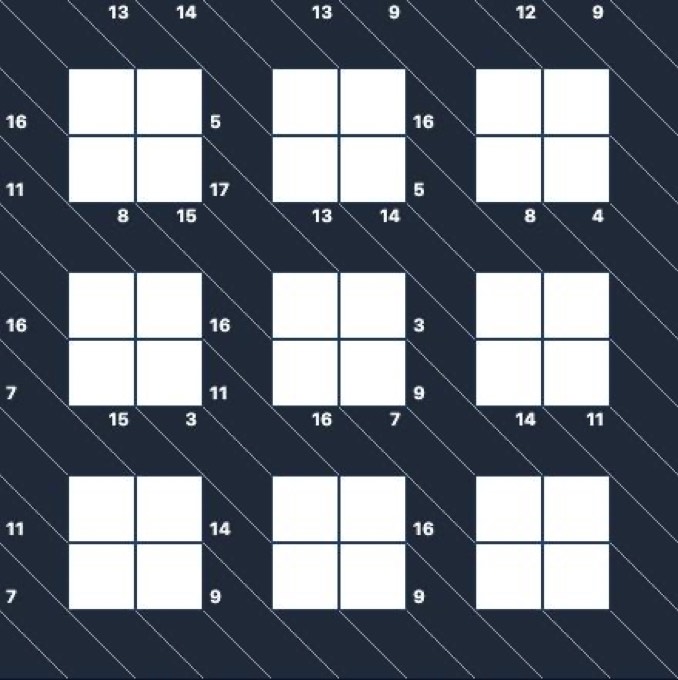
Daily Kakuro is a cross-sums puzzle. Dark squares contain sum clues, and the unshaded cells take digits from 1 to 9. Every horizontal and vertical run has to add up to its clue, with each digit appearing at most once in that run. At a crossing, one digit has to fit both sums. The board reveals more as you narrow combinations and pass that information across the grid.
How to play Daily Kakuro
Choose a white cell, then tap the appropriate number on the on-screen keypad. Read the across clue for that group of cells and the down clue for the intersecting group. Find a valid set of distinct numbers for each sum before trying to assign their order. Correct a digit in the same cell if later crossings rule it out.
Daily Kakuro tips
Begin with short runs and extreme values. A two-cell sum of 3 must use 1 and 2. A two-cell sum of 17 must use 8 and 9. A three-cell sum of 6 is limited to 1, 2 and 3. Once you know a combination, find which crossing helps you decide where each digit goes.
Suppose a cell is part of a two-cell run totaling 16, whose digits must be 7 and 9. The same cell is part of a two-cell run totaling 10, which can use pairs such as 1 and 9, 2 and 8 or 3 and 7. Both 7 and 9 remain possible at that intersection. If another crossing rules out 1 in the second run, it knocks out 9 here with it. The remaining values propagate to both groups.
If an almost complete run is behaving strangely, check the no-repeat rule before trusting the addition. A two-cell run of 10 could appear to work with 5 + 5, but its two cells need distinct digits. When just one square is open, subtract the placed digits from the clue and verify that the difference has not already appeared in that run.
Compare combinations with a crossing
For a two-cell run totaling 11, the possible digit pairs are 2 and 9, 3 and 8, 4 and 7, and 5 and 6. Suppose the first cell shares a down clue whose allowed digits have already narrowed to 1 or 2. That leaves 2 as the only shared digit, so the other cell must be 9. You now have two new values to check against their own vertical sums.
On a longer run, try starting with the bounds. If three empty squares need a subtotal of 24, using any digit below 7 would make the sum impossible even with 8 and 9 beside it. The three digits are 7, 8 and 9. Crossings then decide their order. Use the smallest and largest distinct digits still available when you apply the same idea to the remainder of a partially filled run.